Struggling with knee pain can impact your quality of life, making basic activities like walking, standing, or using stairs feel nearly impossible. If your pain is limited to one part of your knee, a partial knee replacement may be the targeted orthopaedic solution you need.
Dr. Alexander S. McLawhorn, a fellowship-trained orthopedic surgeon specializing in knee and hip replacements, offers patient-focused care in New York, New York, and Stamford, Connecticut. With over 600 joint replacement surgeries performed annually and expertise in minimally invasive and robot-assisted techniques, Dr. McLawhorn is a trusted leader in his field. He can help you regain mobility, relieve pain, and reclaim your active lifestyle.
What Is Partial Knee Replacement?
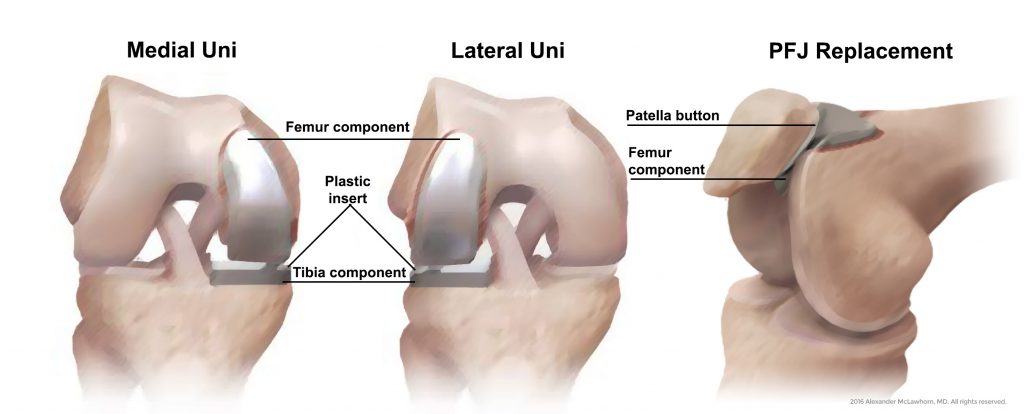
Partial knee replacement surgery, also called “unicompartmental knee arthroplasty”, may refer to “unicondylar knee replacement” or to “patellofemoral joint replacement”. These procedures are sometimes alternatives to total knee replacement surgery.
Rather than removing the entire joint, partial knee replacement involves removing only the damaged portion of the bone and cartilage, and selectively resurfacing those parts of the knee. This type of knee surgery is typically recommended for patients who have damage to cartilage and/or bone that is only in one area of the knee joint.
Dr. McLawhorn performs medial unicompartmental knee arthroplasty only. He does not perform lateral or patellofemoral partial knee replacements.
Reasons For Partial Knee Replacement
Partial knee replacement surgery is commonly performed for patients who are suffering from severe knee pain associated with knee arthritis. Some of the symptoms that may warrant a partial knee replacement include:
- Severe knee pain that is recurring, but specific to one area of the knee joint
- Pain that lasts throughout the day and night, even at rest
- Knee pain that has not responded well to nonsurgical treatments
- Trouble performing normal activities due to debilitating pain
- Knee arthritis damage that is confined to one area of the knee
Partial Knee Replacement Candidates
The most common indications for partial knee replacement are:
- Osteoarthritis, secondary arthritis, or osteonecrosis confined to one compartment of the knee (either medial, lateral, or patellofemoral)
- Intact and functioning knee ligaments (for example, ACL, PCL, and MCL)
- Minimal leg deformity
- Nearly normal knee range of motion
- Good quality bone
- Patients who are not severely overweight
Unlike total knee replacement, partial knee replacement is not recommended for patients with inflammatory arthritis, because other joint compartments are usually affected.
When to Get a Partial Knee Replacement
Choosing to have partial knee replacement surgery is a personal decision that is made together with Dr. McLawhorn. Your preference for surgery, your lifestyle demands, and your expectations for outcomes after surgery aid the decision-making process and will guide your choice between nonsurgical care and partial knee replacement surgery.
In general, when knee pain begins to interfere with your daily life, prevents you from participating in your recreational activities, wakes you from sleep, and/or requires prescription pain medication, partial knee replacement surgery may be a consideration.
The Goals of Partial Knee Replacement Surgery
First and foremost, the purpose of partial knee replacement surgery is to improve pain. Other general goals are:
- Improve knee function
- Provide a stable knee
- Prevent excessive wear of the implanted components
- Avoid complications
Ideally, you can return to work and the activities you love without worrying about your partial knee replacement. After complete recovery from surgery, you might even forget that you had a partial knee replacement.
In contrast to a total knee replacement, most patients do not sense a major difference between a knee with a partial knee replacement and a natural, well-functioning knee.
The Partial Knee Replacement Process
The exact steps and implants for a partial knee replacement procedure will be customized depending on your individual needs. However, in most cases, you can expect the following:
- Regional anesthesia with either a spinal or epidural to numb your body from the waist down; sedation through an IV will allow you to sleep throughout the surgery.

- One or more nerve blocks (injections around sensory nerves) to lessen postoperative pain.
- Antibiotics prior to surgery to prevent infection.
- An incision in front of the knee to access the part of the knee joint that is damaged. The length of the incision is proportional to the depth of the fatty tissue and muscle overlying the knee. It must be long enough to permit full access to the surfaces of the bone that will be replaced, so that the prosthetic components can be placed precisely and accurately. Typically, an incision that is four to five inches long is adequate.
- Damaged cartilage and bone are removed from the compartment that we’re replacing.
- The exposed bone is resurfaced with metal components.
- A highly cross-linked polyethylene (plastic) liner is inserted between the components, providing smooth motion to the joint; a plastic “button” is used to resurface the backside of the patella (kneecap) in the case of a patellofemoral joint replacement, or “PFJ”.
- The soft tissues are closed over the implants.
What to Expect After Partial Knee Replacement
Immediately after surgery, you will be able to walk on your partial knee replacement. For many patients, partial knee replacement is an outpatient surgery, allowing them to go home the same day as surgery.
You can use crutches or a cane for several weeks, if needed. Depending on the demands of your job, you may return to work within two weeks of surgery. You should be able to return to full normal activity, including heavy labor and sports, about six months after surgery.
Dr. McLawhorn recommends routine follow-up for all his partial knee replacement patients. In general, you will be evaluated at six weeks, 12 weeks, one year, two years, five years, and then every five years after surgery. We'll perform a clinical examination and X-rays at each of these visits.
How to Prepare for Partial Knee Replacement Surgery
Here’s how you can get ready for your surgery to help recovery go more smoothly:
- Complete all required lab work and pre-surgery testing.
- Discuss medications and supplements with Dr. McLawhorn’s team.
- Arrange for someone to help you at home after surgery.
- Clear walkways and remove tripping hazards in your home.
- Eat healthy meals and drink plenty of water before surgery.
- Stop smoking and avoid alcohol before your procedure.
- Follow instructions about when to stop eating or drinking before surgery.
- Pack comfortable clothes and any needed paperwork for surgery day.
Frequently Asked Questions
Why Choose Dr. Alexander S. McLawhorn For Partial Knee Replacement?
The success of your knee replacement surgery heavily depends on choosing a skilled and experienced surgeon. Dr. Alexander S. McLawhorn is a fellowship-trained orthopedic surgeon specializing in knee and hip replacements. He performs over 600 joint replacement procedures annually and is one of the nation’s most experienced surgeons. His expertise includes advanced techniques like robot-assisted surgeries, minimally invasive approaches, and rapid recovery joint replacement.
Dr. McLawhorn completed his training at the renowned Hospital for Special Surgery (HSS), where he earned multiple awards for excellence. In 2022, he was recognized as the top joint replacement surgeon in New York State for volume and experience. As Director of Research and Innovation for the Adult Reconstruction and Joint Replacement Service at HSS, he is a leader in advancing techniques to ensure patient outcomes.
Explore Treatment Options for Your Knee Pain
If you are suffering from debilitating knee pain or knee arthritis and exploring partial knee replacement as a treatment option, it is important to seek advice from an orthopedic knee specialist to accurately diagnose and treat your condition. Dr. McLawhorn is a hip and knee specialist at Hospital for Special Surgery, serving patients in New York City and Stamford, Connecticut.
To learn more, call 203-705-2113 (CT) / 212-606-1065 (NYC) today or schedule an appointment by using the form on this page.